
The Ultimate Home Kitchen Refrigerator Buyer's Guide
Choosing the right refrigerator starts with more than size and price. This complete refrigerator buying guide explains how to measure your kitchen, choose the right capacity, compare Top Freezer, Bottom Freezer, Side-by-Side, and French Door models, and decide which features are worth paying for. Find the right refrigerator for your family, kitchen layout, grocery habits, and budget.
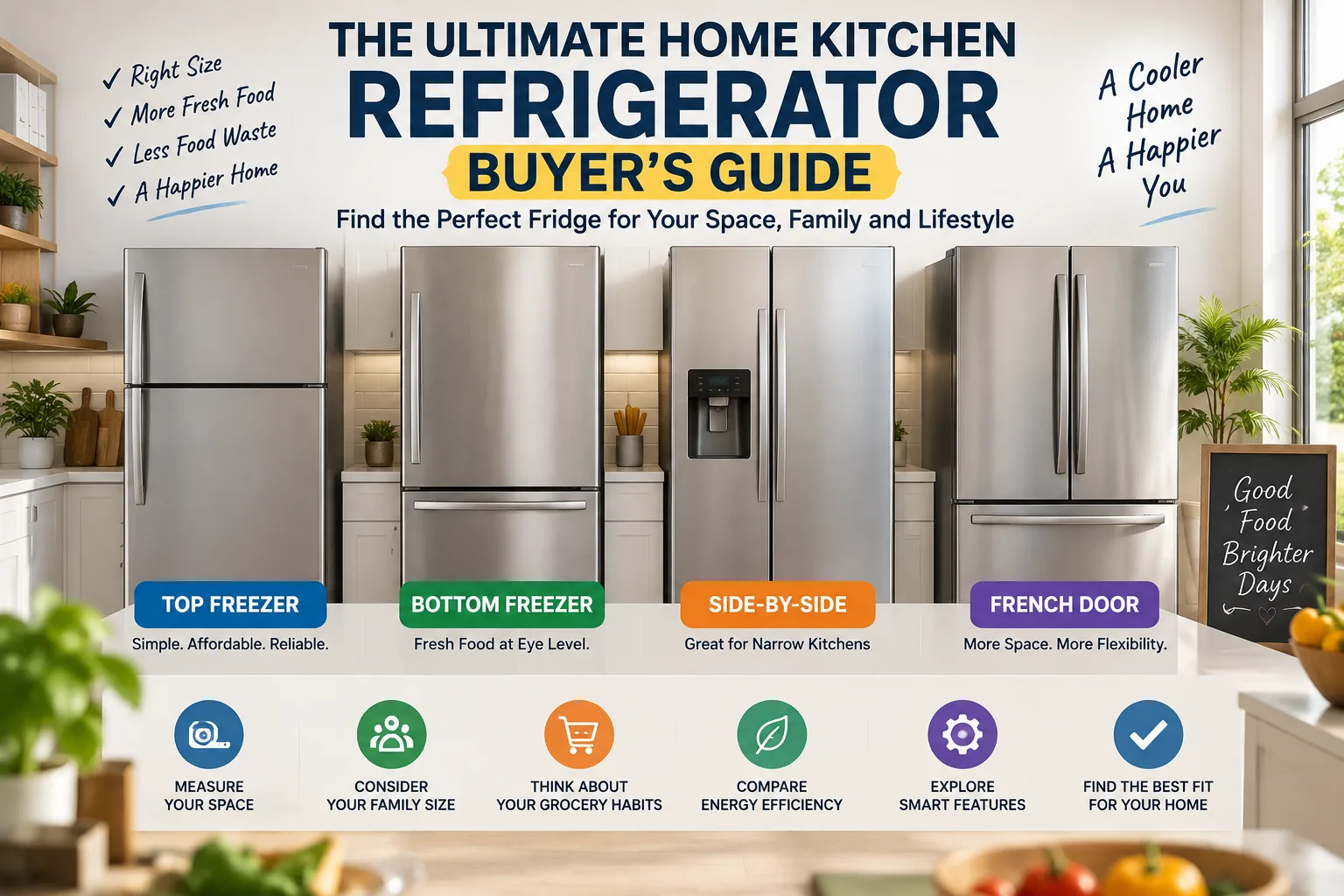
Buying a refrigerator is not just about picking the biggest model that fits your budget. The right fridge should fit your kitchen, match your family size, and work with the way you shop for food.
A good choice can make daily cooking easier, reduce wasted food, and help control energy use. The wrong one can leave you fighting tight doors, crowded shelves, or a freezer that never has enough room.
This guide walks you through the main refrigerator types, sizes, features, prices, and buying factors so you can choose with confidence.
Quick Summary: Which Fridge is Right for You?
- Top Freezer: A good low-cost choice for smaller families, rental homes, and basic kitchens.
- Bottom Freezer: Great if you use fresh food often and want the refrigerator section at eye level.
- Side-by-Side: Works well in narrow kitchens and gives you easy access to both fresh and frozen food.
- French Door: Best for larger families and shoppers who want wide refrigerator storage, flexible shelves, and premium features.
The best refrigerator is the one that fits your kitchen space, gives your household enough usable storage, and matches your grocery habits.
The 3 Master Criteria for Choosing a Refrigerator
Before comparing brands and features, focus on three things: your kitchen, your household, and your shopping habits .
1. Kitchen Layout & Size
A refrigerator can have plenty of storage and still be a poor fit for your kitchen.
Start by measuring the space where the refrigerator will sit. Measure the width, height, and depth of the opening. Then check the manufacturer's installation requirements before buying.
Do not measure only the refrigerator opening.
You also need to think about:
- Door swing
- Wall clearance
- Cabinet clearance
- Handle clearance
- Nearby countertops
- Kitchen islands
- Walkways
- Refrigerator ventilation
- Space needed to open drawers
Counter-Depth vs. Standard-Depth Refrigerators
A counter-depth refrigerator sits closer to the front of your kitchen cabinets. It creates a cleaner look and leaves more room in front of the refrigerator.
The trade-off is storage. Counter-depth models are usually shallower, so they may offer less total storage than standard-depth refrigerators.
A standard-depth refrigerator extends farther into the kitchen but usually provides more storage space for the money.
If your kitchen has a narrow walkway, counter depth may be worth considering. If storage is your top concern, standard depth may make more sense.
Check the Door Swing
This is an easy measurement to miss.
Open the refrigerator doors fully and make sure they do not hit:
- A wall
- Kitchen cabinets
- An island
- Another appliance
- A doorway
French door and side-by-side models can be useful in tighter kitchens because their doors need less front-to-back swing than a wide single-door design.
Also check whether the doors can be reversed. Some refrigerators allow this, while others do not.
Measure Your Delivery Path
Your refrigerator must reach the kitchen before you can use it.
Measure:
- Front door
- Hallways
- Stairways
- Elevator doors
- Turns in the hallway
- Kitchen entry
- Final installation space
A refrigerator that fits the kitchen opening may still be too large to get through the front door.
2. Family Members & Refrigerator Capacity
Your household size is one of the easiest ways to narrow your choices.
As a general starting point:
| Household Size | Suggested Capacity | Approx. US Capacity |
|---|---|---|
| 1 - 2 people | 300 - 400L | 15 - 18 cu. ft. |
| 3 - 4 people | 500 - 600L | 20 - 22 cu. ft. |
| 5+ people | 700L+ | 25+ cu. ft. |
These numbers are starting points, not strict rules.
A family of four that shops several times a week may need less space than a family of three that buys groceries in bulk.
Think About Usable Space
Two refrigerators with the same advertised capacity may not feel the same inside.
Look at:
- Shelf layout
- Door-bin size
- Crisper drawer space
- Freezer drawer size
- Adjustable shelves
- Full-width shelves
- Interior height
- Storage for tall bottles
A refrigerator with smart storage can sometimes feel more spacious than a larger model with poor shelf design.
Fresh Food vs. Frozen Food
Think about what fills your current refrigerator.
If you regularly store:
- Fresh vegetables
- Fruit
- Milk
- Yogurt
- Eggs
- Meat
- Prepared meals
you may want more refrigerator space and larger crisper drawers.
If you buy:
- Frozen meat
- Frozen vegetables
- Frozen meals
- Ice cream
- Bulk frozen foods
look for a larger and better-organized freezer.
3. Purchasing & Grocery Habits
Your shopping routine matters just as much as your family size.
Bulk Grocery Shoppers
If you buy groceries once every week or two weeks, you may need more total storage.
Look for:
- Large freezer capacity
- Deep freezer drawers
- Adjustable shelves
- Wide door bins
- Large crisper drawers
- Flexible storage zones
A French door or bottom freezer refrigerator can work well for this type of shopper.
Fresh-Food Shoppers
If you buy fresh food several times a week, refrigerator space may matter more than freezer space.
Look for:
- Wide refrigerator shelves
- Large produce drawers
- Humidity-controlled crispers
- Easy access to frequently used food
- Flexible shelf positions
Meal Preppers
If you cook several meals in advance, think about container storage.
Wide shelves and adjustable shelves can make a big difference. Check whether your meal containers can fit without wasting vertical space.
Families With Children
A refrigerator with easy-access shelves and organized door storage can make everyday use easier.
A water and ice dispenser may also be convenient, but it adds components that can require maintenance.
When you buy through links on our site, we may earn an affiliate commission at no extra cost to you. This helps support our work.
Choosing the Right Refrigerator Type
There is no single refrigerator design that works for every kitchen.
The four main types in this guide are Top Freezer, Bottom Freezer, Side-by-Side, and French Door .
Each has a different mix of price, storage, accessibility, and kitchen fit.
Top Freezer Refrigerators
Top freezer refrigerators use the traditional layout with the freezer above the main refrigerator compartment. They are often among the least expensive full-size refrigerators and make a good choice for buyers who want simple cooling without many extra features.
Pros
- Usually affordable
- Simple design
- Good refrigerator storage
- Often energy efficient
- Easy to maintain
- Good choice for basic kitchens
Cons
- Freezer is at eye level while the refrigerator is lower
- Bending is required to reach some fresh foods
- Less premium appearance
- Usually fewer smart features
[INTERNAL LINK: Insert link to Top Freezer Sub-Blog]
Bottom Freezer Refrigerators
Bottom freezer refrigerators put the freezer underneath the refrigerator section. This places fresh food at a more convenient height, which can be useful if you open the refrigerator many times each day.
The freezer may be a drawer or a separate bottom compartment.
Pros
- Fresh food is easier to reach
- Good for frequent refrigerator users
- Wide refrigerator shelves are common
- Modern designs
- Good balance of price and convenience
Cons
- Freezer items are lower
- Some models have smaller freezer organization
- Can cost more than basic top-freezer models
[INTERNAL LINK: Insert link to Bottom Freezer Sub-Blog]
Side-by-Side Refrigerators
Side-by-side refrigerators place the freezer and refrigerator next to each other. The narrow doors can be helpful in kitchens where there is not much space for a large door swing.
Many models also include an external water and ice dispenser.
Pros
- Narrow door swing
- Easy access to both refrigerator and freezer
- Good for narrow kitchens
- External ice and water are common
- Vertical storage works well for frozen foods
Cons
- Refrigerator shelves can be narrow
- Wide trays may not fit easily
- Some models have less usable space than similarly sized French door models
- Ice and water systems add complexity
[INTERNAL LINK: Insert link to Side-by-Side Sub-Blog]
French Door Refrigerators
French door refrigerators have two refrigerator doors at the top and a freezer section underneath. This design gives you wide refrigerator storage while reducing the door swing compared with a large single-door refrigerator.
Premium models can include smart screens, Wi-Fi, internal cameras, flexible cooling zones, and advanced food-management features.
Pros
- Wide refrigerator shelves
- Large fresh-food storage area
- Good for families
- Reduced door swing
- Flexible storage options
- Many premium models offer smart features
Cons
- Usually more expensive
- More complex design
- Ice makers can take up storage
- Freezer items are lower
- Premium features can increase the price
[INTERNAL LINK: Insert link to French Door Sub-Blog]
Refrigerator Types & Price Ranges
Prices vary by brand, size, finish, dispenser options, and smart features. Use these ranges as general buying categories rather than fixed prices.
| Refrigerator Type | Best Kitchen Layout Fit | Ideal Family Size | Average Price Range | Detailed Guide |
|---|---|---|---|---|
| Top Freezer | Standard or compact kitchens | 1 - 4 people | $500 - $1,500 | Top Freezer Refrigerator Guide |
| Bottom Freezer | Kitchens with frequent refrigerator use | 2 - 5 people | $900 - $2,500 | Bottom Freezer Refrigerator Guide |
| Side-by-Side | Narrow walkways and kitchens | 2 - 5 people | $1,000 - $3,000 | Side-by-Side Refrigerator Guide |
| French Door | Larger kitchens and family homes | 3 - 6+ people | $1,500 - $4,500+ | French Door Refrigerator Guide |
Energy Efficiency & Smart Features Comparison
Energy use can have a bigger impact over many years than the difference in purchase price.
Look for the ENERGY STAR® label when shopping in the U.S. Also check the refrigerator's estimated annual energy use rather than relying only on the label.
Smart features are a separate decision. A refrigerator can be energy efficient without having Wi-Fi, a touchscreen, or an internal camera.
| Model Category | Energy Efficiency Rating | Smart Features Included | Smart App/Voice Availability | Best Model |
|---|---|---|---|---|
| Budget/Basic Model | Standard efficiency; ENERGY STAR options available | Basic temperature controls, adjustable shelves | Usually none | Best Budget Refrigerator |
| Mid-Range Inverter Model | High efficiency; inverter compressor on many models | Digital controls, temperature alerts, some diagnostics | Available on selected models | Best Mid-Range Inverter Refrigerator |
| Premium Smart/Connected Model | High efficiency models available | Wi-Fi diagnostics, touchscreens, internal cameras, flexible cooling zones | App control and voice assistant support on selected models | Best Smart Refrigerator |
Do You Need Smart Refrigerator Features?
Smart features can be useful if they solve a real problem.
For example, Wi-Fi alerts can tell you when the door has been left open. Remote temperature controls can be useful when you are away from home.
Internal cameras can help you check what is inside while grocery shopping.
Touchscreens, recipe tools, and entertainment features are more about convenience. They may not be worth paying extra for if you only want reliable cold storage.
Refrigerator Features Worth Comparing
Once you choose the refrigerator type, compare the features that affect daily use.
Inverter Compressor
An inverter compressor can adjust its speed instead of simply switching between full power and off.
This can help reduce energy use and may provide steadier cooling. Actual savings depend on the refrigerator design, climate, usage, and efficiency rating.
Adjustable Shelves
Adjustable shelves make it easier to store tall bottles, large containers, and unusual-shaped food.
Look for shelves that are easy to move and feel sturdy.
Crisper Drawers
If you buy lots of fruits and vegetables, pay close attention to crisper storage.
Humidity controls can help create a better storage environment for different types of produce.
Water and Ice Dispenser
External water and ice can be convenient.
But the dispenser and ice maker add more parts to the refrigerator. They can also take up interior storage.
If you rarely use filtered water or ice, a model without a dispenser may offer more storage and a simpler design.
Door Alarm
A door alarm is a small feature that can prevent wasted energy and spoiled food if someone leaves the refrigerator open.
It can be especially useful in homes with children.
Wi-Fi Connectivity
Wi-Fi can allow you to:
- Check refrigerator status
- Receive temperature alerts
- Get door-open notifications
- Run certain diagnostics
- Adjust selected settings remotely
Not every smart feature works on every model, so check the manufacturer's app and supported functions before buying.
Flexible Cooling Zones
Some premium refrigerators let you change the temperature or purpose of a section.
For example, a compartment may work as refrigerator, freezer, or another temperature-controlled zone depending on the model.
This can be useful for households whose storage needs change during the week.
Counter-Depth vs. Standard-Depth: Which Should You Buy?
Choose counter depth if you want a cleaner built-in look, have a narrow kitchen walkway, or want the refrigerator to sit closer to your cabinets.
Choose standard depth if you want maximum storage and have enough room for the refrigerator to extend farther into the kitchen.
Before buying, compare the actual exterior dimensions and usable interior capacity . "Counter depth" is not a universal size, so dimensions can vary between brands.
How Much Refrigerator Capacity Do You Really Need?
More capacity is not always better.
An oversized refrigerator can cost more and may waste kitchen space. An undersized refrigerator can leave you constantly rearranging food.
Start with your household size, then adjust for shopping habits.
Two people + frequent grocery shopping:
A smaller refrigerator may be enough.
Four people + weekly bulk shopping:
Look for a larger refrigerator and freezer.
Five or more people + meal preparation:
Prioritize large fresh-food shelves, big crisper drawers, and a well-organized freezer.
Think about usable storage , not just the number printed on the product page.
How to Choose a Refrigerator for a Small Kitchen
Small kitchens need more attention to dimensions than feature lists.
Consider:
- Counter-depth models
- French doors
- Side-by-side designs
- Narrower refrigerator widths
- Reversible doors where available
- Reduced door-swing requirements
Do not sacrifice ventilation space just to squeeze in a larger refrigerator. Follow the manufacturer's required clearances.
How to Choose a Refrigerator for a Large Family
Large families usually benefit from more storage and better organization.
Look for:
- 25+ cu. ft. capacity as a starting point
- Wide refrigerator shelves
- Large produce drawers
- Flexible shelves
- Large freezer storage
- Multiple temperature zones
- Strong door storage
- Easy-to-clean interiors
A large French door refrigerator is often a strong option, but a large side-by-side or bottom-freezer model may also fit depending on your kitchen.
Should You Buy a Smart Refrigerator?
A smart refrigerator makes the most sense when you will use its connected features.
Smart features may be worth it if you want:
- Remote temperature alerts
- Door-open notifications
- Wi-Fi diagnostics
- Internal cameras
- Shopping or food-management tools
- Voice control
- Flexible temperature controls
A basic refrigerator may be better if:
- You want the lowest purchase price
- You prefer simple appliances
- You do not use smartphone appliance apps
- You want fewer electronic components
- You mainly care about cooling and storage
Do not pay for a touchscreen simply because it looks impressive. Buy features that you will actually use.
Refrigerator Buying Checklist
Before you place an order, check each item below.
Kitchen Fit
- Width measured
- Height measured
- Depth measured
- Door swing checked
- Wall clearance checked
- Cabinet clearance checked
- Walkway clearance checked
- Delivery path measured
- Ventilation requirements checked
Storage
- Capacity matches household size
- Freezer space matches shopping habits
- Crisper space is large enough
- Shelves fit your containers
- Door bins fit bottles and cartons
- Freezer drawers are easy to organize
Features
- ENERGY STAR rating checked
- Annual energy use checked
- Compressor type checked
- Ice maker needs considered
- Water dispenser needs considered
- Wi-Fi features checked
- App compatibility checked
- Warranty reviewed
Budget
Do not look only at the sticker price.
Consider:
- Purchase price
- Delivery
- Installation
- Water-line installation if required
- Extended warranty
- Energy use
- Future maintenance
Frequently Asked Questions
What is the difference between counter-depth and standard-depth refrigerators?
Counter-depth refrigerators are shallower and sit closer to the front of your cabinets. Standard-depth refrigerators extend farther into the kitchen but usually provide more interior storage.
How long do modern refrigerators last?
Many modern refrigerators can last around 10 to 15 years , although lifespan varies by model, usage, maintenance, and repair history. Some units last longer, while heavily used or poorly maintained models may need replacement sooner.
Are smart refrigerators worth the extra cost?
They can be worth it if you will use features such as Wi-Fi alerts, remote controls, diagnostics, cameras, or flexible temperature zones. If you only need reliable cooling and storage, a less expensive refrigerator may provide better value.
What size refrigerator is best for a family of four?
A family of four will often find 20 - 22 cu. ft. of capacity a useful starting range, or roughly 500 - 600 liters . Increase capacity if you buy groceries in bulk, freeze large amounts of food, or prepare meals in advance.
Final Verdict: Choose the Refrigerator Around Your Life
The best refrigerator is not necessarily the largest or most expensive model.
Start with your kitchen measurements. Then consider your family size and shopping habits. After that, choose the refrigerator type and features that solve your everyday needs.
For a simple and affordable option, start with a Top Freezer . For easier access to fresh food, consider a Bottom Freezer . If kitchen space is tight, a Side-by-Side may work well. For families that want wide refrigerator storage and more features, a French Door model is often a strong choice.
Find the Right Refrigerator for Your Home
Ready to narrow it down?
Explore our individual refrigerator guides to compare the best brands, features, prices, and models for your kitchen:
- Top Freezer Refrigerator Guide
- Bottom Freezer Refrigerator Guide
- Side-by-Side Refrigerator Guide
- French Door Refrigerator Guide
Use the deep-dive guides to find the exact refrigerator model that fits your space, budget, family, and buying habits.
CoreAdorn is reader-supported. When you buy through links on our site, we may earn an affiliate commission.
0 Comments
Be the first to comment.
Leave a comment
Please use kind words and keep your comment on topic. Comments are reviewed by the CoreAdorn team before they appear.