
Best Salary Negotiation Books and Resources for Professionals
Learn how to prepare for salary negotiations with practical books, planners, and resources covering job offers, raises, promotions, total compensation, communication, and workplace negotiation.
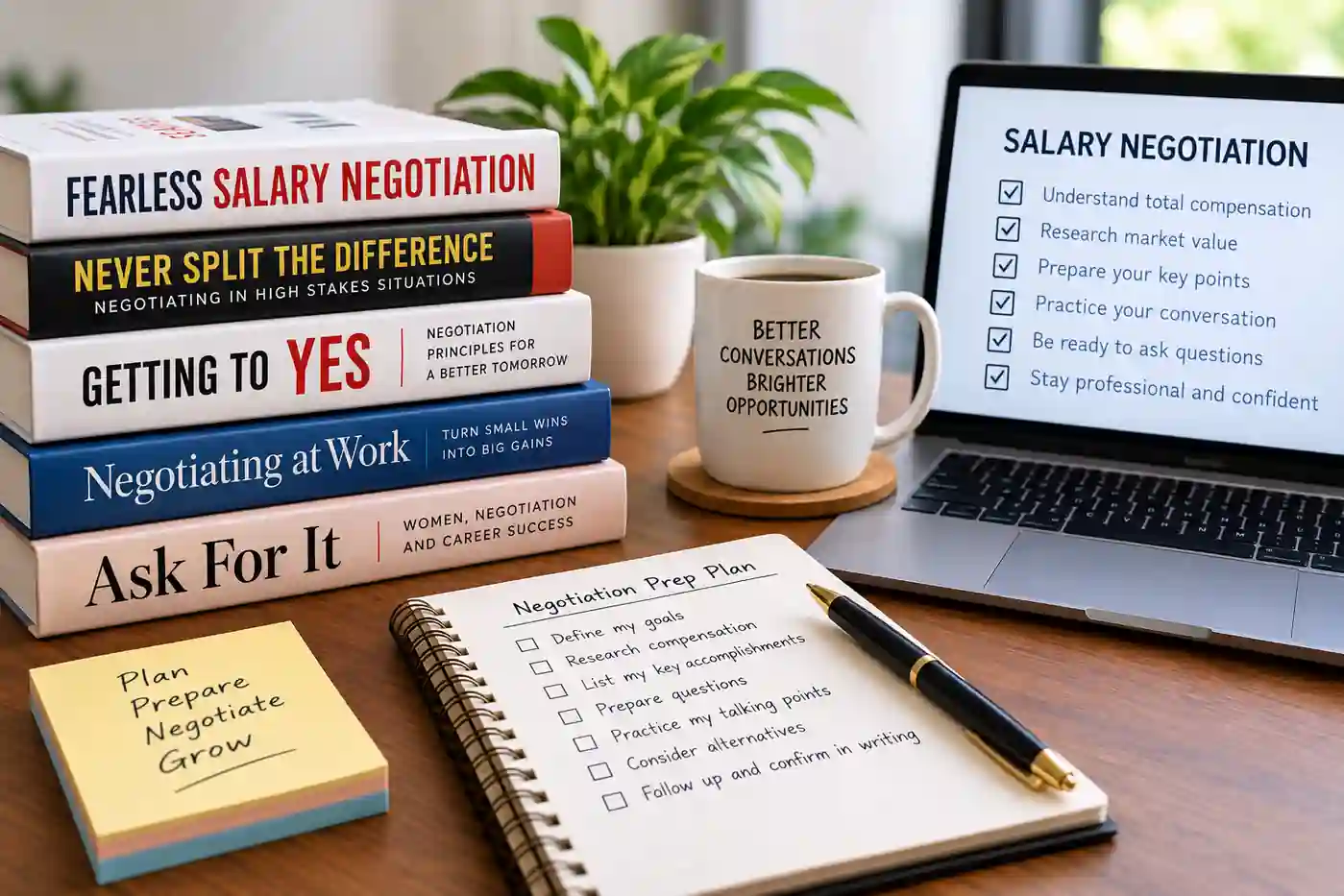
Salary negotiation is not only about asking for a higher number. For many professionals, compensation discussions can involve base pay, bonuses, benefits, equity, title, responsibilities, flexibility, and the timing of future compensation reviews.
The challenge is knowing what to ask for, when to ask, how to prepare, and how to communicate without turning the conversation into a confrontation.
A good salary negotiation book can provide scripts, frameworks, examples, and exercises you can review before an important conversation. Physical planners and notebooks can also help you organize accomplishments, compensation research, questions, and negotiation priorities.
For a broader look at financial and career resources, see CoreAdorn's Personal Finance & Career guide.
Quick Answer: What Should You Read Before a Salary Negotiation?
The right resource depends on the situation.
- Negotiating a new job offer: Look for a salary-specific guide such as Fearless Salary Negotiation .
- Learning general negotiation skills: Getting to Yes provides a principles-based framework for negotiating agreements.
- Improving communication under pressure: Never Split the Difference focuses heavily on listening, questioning, emotional dynamics, and communication.
- Negotiating raises, promotions, and workplace opportunities: Negotiating at Work is specifically focused on organizational and workplace negotiations.
- Building confidence around asking: Ask For It focuses on negotiation strategies and preparation, with particular attention to situations faced by women.
- Organizing your case: A career planner or dedicated notebook can help track accomplishments, measurable results, target compensation, questions, and priorities.
A book cannot determine what your employer will offer or whether a negotiation will succeed. Its value is primarily in helping you prepare more deliberately.
When you buy through links on our site, we may earn an affiliate commission at no extra cost to you. This helps support our work.
Who This Article Is For
This guide is intended for U.S. professionals who are:
- Considering a new job offer
- Preparing to ask for a raise
- Moving into a higher-level role
- Discussing compensation after a promotion
- Trying to understand total compensation
- Returning to the workforce
- Changing careers or industries
- Preparing for a performance review
- Looking for practical salary negotiation books
- Building better negotiation and communication skills
If you're earlier in the career-planning process, our guide to career planners for professionals can help you organize longer-term goals before compensation becomes the immediate issue.
Why Salary Negotiation Matters
Compensation affects more than your next paycheck.
Base salary can influence future raises, percentage-based bonuses, retirement contributions, and sometimes future offers. Benefits can also have meaningful financial value, while equity or long-term incentives may become an important part of compensation for some roles.
That does not mean every employee should negotiate every part of every offer.
The practical goal is to understand the complete compensation package and the flexibility available in your particular situation.
For example, two job offers with similar salaries may differ considerably in:
- Annual bonus opportunities
- Sign-on bonuses
- Retirement contributions
- Health insurance costs
- Paid time off
- Equity or stock awards
- Severance provisions
- Remote or hybrid arrangements
- Professional development support
- Relocation assistance
- Work schedule or flexibility
Some items may be negotiable while others may be standardized by company policy.
When Is Salary Negotiation Appropriate?
Negotiation may be appropriate when there is an actual decision or discussion about compensation.
A New Job Offer
This is one of the clearest opportunities to discuss compensation because the employer has already expressed interest in hiring you.
You may have room to discuss:
- Base salary
- Bonus
- Sign-on bonus
- Equity
- Vacation or PTO
- Start date
- Relocation assistance
- Professional development
- Other benefits, depending on company policy
Not every employer has the same flexibility, so avoid assuming that every item is negotiable.
Asking for a Raise
A raise discussion generally works better when it is connected to your responsibilities, measurable contributions, expanded scope, or market information rather than simply personal expenses.
Your rent, mortgage, childcare costs, or other household expenses may be important to you, but they don't necessarily establish the business case for changing your compensation.
Promotion Compensation
A promotion can be an appropriate time to discuss compensation because your responsibilities, title, expectations, or scope may be changing.
Ideally, compensation should be discussed as part of the promotion conversation rather than treated as an unrelated topic afterward.
Expanded Responsibilities
Sometimes your job changes without an official promotion.
If your responsibilities have materially expanded, that may create an appropriate opportunity to discuss whether your role and compensation still align with the position you're performing.
Annual or Performance Reviews
A performance review may provide a natural point for compensation discussions, although the timing and process vary significantly among employers.
Preparing for a Salary Negotiation
Preparation is usually more useful than memorizing a clever phrase.
Before the conversation, create a simple negotiation worksheet or notebook page containing five areas.
1. Your Current Compensation
Record the components of your existing package:
- Base salary
- Bonus
- Equity
- Retirement contributions
- Insurance costs
- PTO
- Other meaningful benefits
This gives you a complete reference point rather than focusing only on salary.
2. Your Target
Decide what you would ideally like to receive.
This does not mean assuming the employer will agree. It simply gives you a reference point before the conversation starts.
3. Your Minimum Acceptable Outcome
Think about what would make the opportunity worthwhile based on your circumstances and alternatives.
Avoid choosing a number impulsively during the conversation.
4. Your Evidence
Prepare specific examples of:
- Revenue generated
- Costs reduced
- Projects delivered
- Customers retained
- Processes improved
- Responsibilities added
- Teams supported
- Problems solved
- Certifications or skills acquired
- Measurable performance improvements
Use evidence that is relevant to the role.
5. Your Alternatives
Consider what you will do if the employer cannot meet your preferred compensation.
- Accept the existing offer
- Negotiate another component
- Ask about a future compensation review
- Continue interviewing
- Decline the opportunity
Having alternatives can make the conversation less reactive.
Understanding Total Compensation
Salary is only one component of compensation.
Base Salary
Base salary is the fixed amount you receive before variable compensation and many deductions.
When comparing opportunities, look beyond the headline number.
A higher base salary may be attractive, but the overall package can include other components that materially change the financial picture.
Bonuses
Bonuses can be discretionary, performance-based, guaranteed for a specific period, or tied to company or individual results.
Ask questions such as:
- Is the bonus guaranteed?
- What determines eligibility?
- Is there a target percentage?
- When is it paid?
- What happens if I join partway through the year?
Do not automatically treat a target bonus as guaranteed income.
Benefits
Benefits can include:
- Health insurance
- Dental and vision coverage
- Retirement contributions
- Paid time off
- Life or disability insurance
- Tuition assistance
- Professional development
- Flexible work arrangements
When comparing offers, consider the employee contribution and actual terms rather than simply checking whether a benefit exists.
Equity
Equity may be part of compensation for certain companies and roles.
Depending on the employer and plan, equity can involve different structures and conditions.
Ask about:
- Type of equity
- Vesting schedule
- Grant amount
- Exercise or purchase requirements where applicable
- Tax considerations
- What happens when employment ends
Equity can be considerably more complex than salary. For significant equity packages, consider obtaining appropriate professional financial or tax advice rather than relying solely on a negotiation book.
Negotiating a New Job Offer
A new offer can create a different dynamic from asking for a raise.
The employer has already decided that your skills fit the position, but you still need to understand the complete package before responding.
- Thank the employer for the offer.
- Ask for time to review the details if needed.
- Review the entire compensation package.
- Research the role and relevant market information.
- Identify your priorities.
- Decide what you want to discuss.
- Make a clear, professional request.
- Listen to the employer's response.
- Ask whether other components are flexible if base salary cannot move.
- Get the final agreement in writing.
Avoid negotiating based solely on what you earned at your previous employer.
Your previous salary may not reflect the market value of the new role, especially after a career change, promotion, geographic move, or change in responsibilities.
Asking for a Raise
A raise conversation is different from a new-job negotiation because your employer already knows your work.
Build your case around the value and scope of your contribution.
A useful structure is:
What changed -> What you accomplished -> Why it matters -> What you're requesting
For example:
"Over the past year, my responsibilities have expanded to include X and Y. I also delivered A, B, and C, which contributed to [specific business result]. I'd like to discuss whether my compensation can be adjusted to reflect the scope of my current role."
The objective is not to pressure the manager into saying yes immediately. You are opening a compensation discussion.
If the answer is no, ask useful follow-up questions:
- What would need to change for compensation to be reconsidered?
- Is there a formal review cycle?
- What expectations would I need to meet?
- When would be a reasonable time to revisit the discussion?
- Is there another form of compensation that may be available?
A negotiation book can help you prepare for these conversations, but company budgets, compensation structures, performance policies, and managerial authority vary.
Negotiating Promotion Compensation
A promotion discussion should cover more than the new title.
Ask about:
- New responsibilities
- Expected performance
- Base salary
- Bonus eligibility
- Equity where applicable
- New reporting responsibilities
- Review timing
- Career progression
If you are already performing many responsibilities associated with the next level, document when those responsibilities began and what outcomes you delivered.
This can make the discussion more concrete.
Our interview preparation books guide can also be useful when a promotion process includes a formal interview or assessment.
Communication Strategies That Can Help
Good negotiation communication is usually clear rather than aggressive.
Ask Open Questions
Instead of immediately arguing about a number, ask questions that reveal how the compensation package was determined.
- "How did you arrive at the base salary?"
- "Is there flexibility in the base salary?"
- "Which parts of the package have flexibility?"
- "How does the company structure compensation for this level?"
Use Specific Evidence
Replace vague statements such as "I deserve more" with concrete information about responsibilities and results.
Avoid Overexplaining
A long explanation can dilute your main request.
State the request clearly, provide the relevant evidence, and allow the other person to respond.
Don't Fill Every Silence
You don't need to immediately respond to every pause.
Give the other person time to consider the request.
Keep the Relationship Professional
Negotiation does not have to be adversarial.
You can advocate for your interests while recognizing the employer's constraints.
Salary Negotiation Books by Use Case
| Book | Best For | Key Consideration |
|---|---|---|
| Fearless Salary Negotiation - Josh Doody | Job offers, raises and promotions | More directly focused on compensation than general negotiation books |
| Never Split the Difference - Chris Voss with Tahl Raz | Communication and difficult negotiations | Uses high-stakes negotiation examples that require adaptation to ordinary workplace situations |
| Getting to Yes - Roger Fisher, William Ury and Bruce Patton | Learning negotiation principles | Broader than salary negotiation |
| Negotiating at Work - Deborah M. Kolb and Jessica L. Porter | Workplace negotiations and career opportunities | Focuses on organizational context and workplace dynamics |
| Ask For It - Linda Babcock and Sara Laschever | Building confidence around asking | Particularly focused on women's negotiation experiences |
For a Salary-Specific Approach: Fearless Salary Negotiation
Best for: Professionals preparing for job offers, raises, or promotions.
Josh Doody's Fearless Salary Negotiation is one of the more directly relevant books for someone who wants a resource focused specifically on compensation.
Key features:
- Compensation-focused framework
- Market-value discussion
- Job-offer negotiation
- Raise discussions
- Promotion discussions
- Practical negotiation steps
Important limitation: Its approach is specifically oriented toward salary and compensation. Someone looking for a broader introduction to negotiation may prefer a general negotiation book.
Who should consider it: Job seekers and professionals preparing for a compensation conversation.
Who may want an alternative: Someone primarily interested in negotiation psychology, workplace conflict, or broader business negotiations.
For Communication Skills: Never Split the Difference
Best for: Professionals who want to improve listening, questioning, and communication during difficult conversations.
Chris Voss's Never Split the Difference , written with Tahl Raz, draws on Voss's experience as a former FBI negotiator and adapts negotiation concepts for business and everyday situations.
Key features:
- Tactical empathy
- Listening techniques
- Questioning strategies
- Handling difficult conversations
- Negotiation under pressure
Important limitation: Some examples come from high-stakes hostage negotiation, which is very different from discussing compensation with an employer.
Who should consider it: Professionals who want broader negotiation and communication skills.
Who may want an alternative: Someone who needs a step-by-step salary negotiation resource specifically focused on compensation.
For Negotiation Fundamentals: Getting to Yes
Best for: Professionals who want a foundation in principled negotiation.
Getting to Yes by Roger Fisher, William Ury, and Bruce Patton presents a framework built around separating people from problems, focusing on interests, developing options, and using objective criteria.
For salary discussions, the principles can help you think beyond a simple "my number versus their number" approach.
For example, if base salary cannot move, other aspects of an employment package may deserve discussion.
Key features:
- Principled negotiation
- Interests versus positions
- Objective criteria
- Collaborative problem solving
- Negotiation fundamentals
Important limitation: It is not specifically written for employment compensation.
Who should consider it: Professionals who want a general negotiation framework they can use at work and outside work.
Who may want an alternative: Readers who want scripts and examples specifically for salary offers and raises.
For Workplace Negotiations: Negotiating at Work
Best for: Professionals negotiating promotions, opportunities, flexibility, support, recognition, or other workplace issues.
Negotiating at Work: Turn Small Wins into Big Gains by Deborah M. Kolb and Jessica L. Porter focuses specifically on negotiation within organizations.
Key features:
- Workplace negotiation
- Promotions
- Opportunities
- Flexibility
- Organizational dynamics
- Negotiating with people who have more authority
Important limitation: It takes a broader workplace perspective rather than functioning as a salary-only handbook.
Who should consider it: Employees preparing for workplace changes, promotions, or expanded responsibilities.
Who may want an alternative: Someone who simply needs a concise salary-offer negotiation guide.
For Building Confidence Around Asking: Ask For It
Best for: Readers who want a structured approach to asking for raises, promotions, assignments, and other professional opportunities.
Linda Babcock and Sara Laschever's Ask For It focuses on negotiation and includes a structured approach involving goals, bargaining power, strategy, and managing reactions.
Key features:
- Preparing before negotiation
- Identifying goals
- Building bargaining power
- Developing a strategy
- Handling reactions
- Raises and promotions
Important limitation: The book's framing is specifically centered on women and their negotiation experiences.
Who should consider it: Women who want a negotiation resource that directly addresses their experiences and concerns.
Who may want an alternative: Readers looking for a gender-neutral salary negotiation manual.
Physical Career Resources for Salary Negotiation
Books aren't the only useful physical resources.
A simple paper-based system can be valuable when you're preparing for an important conversation because it gives you a place to organize information away from your inbox.
Career Planner
A professional career planner can help you track:
- Career goals
- Accomplishments
- New responsibilities
- Skills
- Certifications
- Promotion milestones
- Performance-review notes
See our guide to career planners for professionals if you want a dedicated planning system.
Professional Notebook
A dedicated notebook can be useful for maintaining an ongoing career evidence file.
Create sections for:
- Accomplishments
- Metrics
- Positive feedback
- Projects
- Skills
- Compensation research
- Negotiation questions
- Future goals
This can be particularly useful if you update it throughout the year instead of trying to reconstruct a year's worth of achievements immediately before a review.
Negotiation Worksheet or One-Sheet
A one-page worksheet can help you organize:
- Target compensation
- Current compensation
- Priorities
- Evidence
- Questions
- Alternatives
- Non-negotiables
How to Choose the Right Salary Negotiation Resource
Start with the problem you are trying to solve.
If You Have a Job Offer
Choose a salary-focused resource and prepare your compensation worksheet before responding.
If You Are Asking for a Raise
Look for resources covering internal compensation, performance evidence, workplace dynamics, and follow-up conversations.
If You Are Negotiating a Promotion
A workplace negotiation book may be more useful than a book focused only on starting salaries.
If Communication Is Your Biggest Concern
A general negotiation book can help you practice listening, questioning, and handling difficult conversations.
If You Want a Long-Term System
Combine a negotiation book with a career planner or notebook that you maintain throughout the year.
Who Should Buy a Salary Negotiation Book?
- You have an upcoming job offer
- You're uncomfortable discussing compensation
- You want to practice before a conversation
- You want scripts or examples
- You're preparing for a promotion
- You want to improve general negotiation skills
- You prefer learning from a physical book
Who May Want to Skip One?
- You already have a negotiation framework that works for you
- Your employer has a highly standardized compensation process
- You only need basic market research
- You have access to professional career coaching or workplace resources
- You are looking for legal or tax advice rather than negotiation education
A book should be treated as an educational resource, not as a substitute for professional legal, tax, or financial advice.
You may not need to purchase a book if:
You may not need to purchase a book if:
Common Salary Negotiation Mistakes
Negotiating Without Research
A random number is difficult to defend.
Understand the role, responsibilities, relevant market information, and your own priorities before making a request.
Focusing Only on Base Salary
Consider the full compensation package.
Using Personal Expenses as Your Main Argument
Your household expenses are real, but an employer generally evaluates compensation based on the role, internal structures, market conditions, performance, and organizational constraints.
Treating a Bonus as Guaranteed
A target bonus and guaranteed compensation are not necessarily the same thing.
Making Threats You Cannot Follow Through On
Don't say you'll reject an offer or resign unless you are genuinely prepared to do so.
Negotiating Every Detail
Not every issue needs to become a negotiation. Prioritize the items that matter most.
Forgetting to Get Agreements in Writing
Once the discussion is complete, review the written offer or updated compensation documentation to make sure you understand what was agreed upon.
Treating Negotiation as a Fight
The goal is to advocate for your interests while maintaining a professional relationship.
Frequently Asked Questions
Is it worth reading a salary negotiation book before asking for a raise?
It can be useful if you are unfamiliar with negotiation or want to practice before an important conversation. A good book can help you organize your evidence, identify priorities, develop questions, and rehearse how you want to communicate. It cannot predict your employer's response or guarantee a particular compensation outcome.
What is the best book for negotiating a new job offer?
There is no single book that is right for every reader. A salary-specific resource such as Fearless Salary Negotiation is designed around job offers, raises, and promotions. Broader books such as Getting to Yes or Never Split the Difference can be useful if you also want general negotiation and communication skills.
Should I negotiate salary after receiving a job offer?
You can consider discussing compensation after receiving an offer, provided you understand the offer and the employer's process. Review base salary, bonus, benefits, equity where applicable, and other important terms before responding. Ask clear questions and make a professional request rather than assuming that every part of the package is negotiable.
What should I negotiate besides salary?
Depending on the employer and role, you may be able to discuss items such as bonuses, sign-on compensation, equity, start date, professional development, relocation assistance, PTO, or work arrangements. Some benefits may be standardized and non-negotiable. Always confirm the actual terms instead of assuming flexibility.
How should I ask for a raise?
Start with evidence about your responsibilities, accomplishments, measurable results, and how your role has changed. Then make a clear compensation request and ask what the next steps are. If the employer cannot approve an increase immediately, ask what conditions or timing would support a future review.
Can a career planner help with salary negotiation?
Yes, primarily as an organization tool. A career planner can help you maintain records of accomplishments, projects, skills, responsibilities, feedback, and goals. That information can make it easier to prepare for performance reviews, promotions, and compensation conversations without trying to reconstruct your achievements at the last minute.
Should I negotiate equity as part of compensation?
If equity is included in an offer and you understand the terms, it can be appropriate to ask questions about it. Equity can have complicated financial and tax implications, so don't evaluate it solely by the headline grant amount. For significant equity packages, consider obtaining appropriate professional financial or tax advice.
What if my employer says no to a raise?
A rejection does not necessarily end the conversation. Ask whether there are specific performance expectations, role changes, review dates, or other conditions that would support reconsideration later. You can also ask whether another form of compensation or professional development support is available. Avoid assuming that a future raise is guaranteed.
Final Thoughts
Salary negotiation is easier to approach when you separate the preparation from the conversation.
Research your role. Understand the complete compensation package. Keep an ongoing record of your accomplishments. Decide what matters most to you. Then communicate your request clearly and professionally.
The right book depends on your situation. A salary-specific guide may be useful before a job offer, while a broader negotiation book can help build skills that apply to promotions, workplace discussions, and other professional situations.
For the larger picture, explore CoreAdorn's Personal Finance & Career guide , which connects salary and career decisions with practical resources for budgeting, planning, productivity, and professional development.
CoreAdorn is reader-supported. When you buy through links on our site, we may earn an affiliate commission.
0 Comments
Be the first to comment.
Leave a comment
Please use kind words and keep your comment on topic. Comments are reviewed by the CoreAdorn team before they appear.