
Best Career Planners for Professionals: Tools for Setting Career Goals and Tracking Progress
Looking for a career planner? Compare goal planners, productivity planners and digital tools for career changes, job searches, promotions, skill development and professional growth.
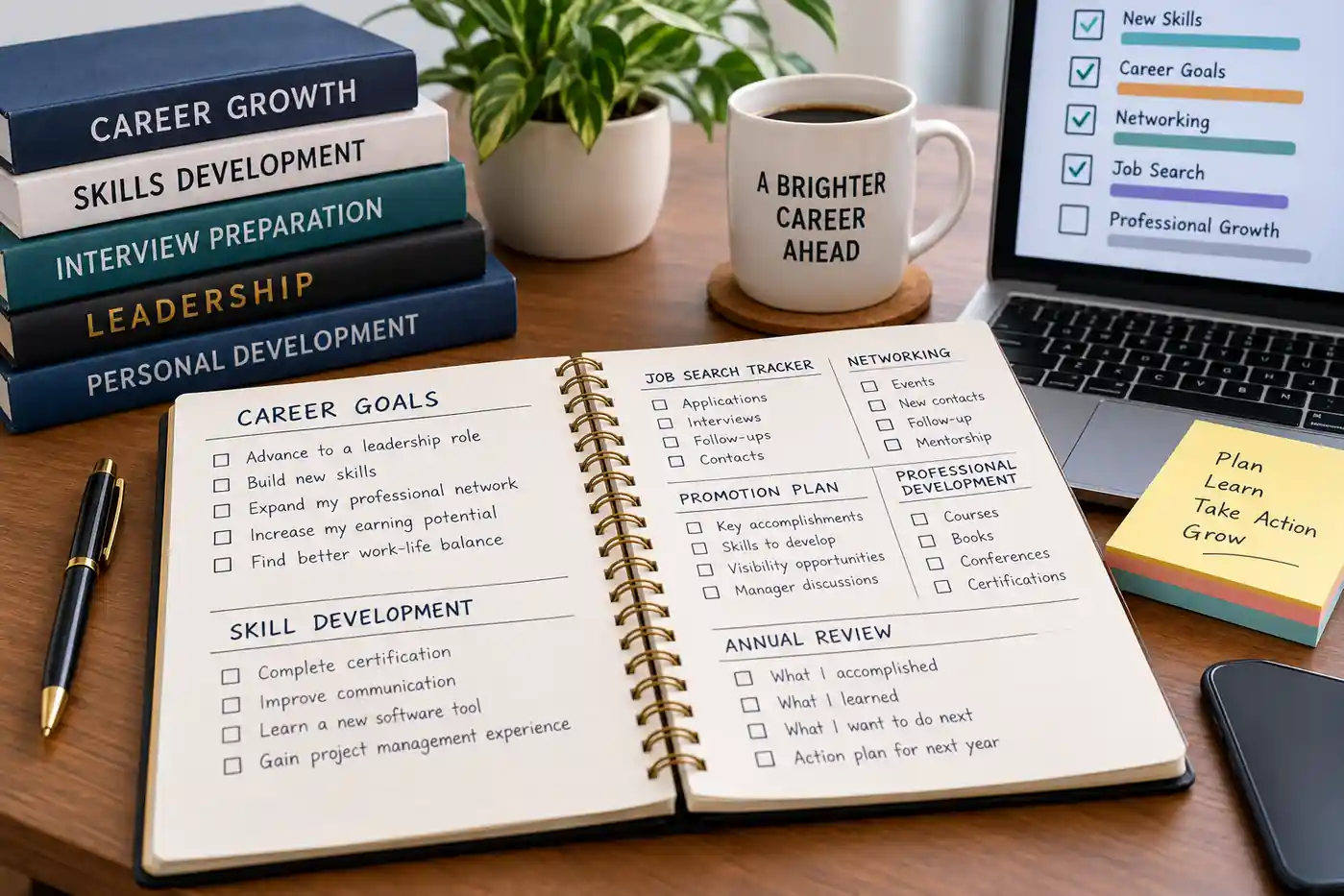
A career plan doesn't have to be a complicated five-year document that gets forgotten in a drawer. For many professionals, a useful career planner is simply a place to define goals, identify skills to build, track important conversations, prepare for opportunities, and review progress throughout the year.
A career planner is also different from a regular daily planner. A daily planner helps you manage what needs to happen today. A career planner helps you decide where your professional life is going and what needs to happen next.
This guide looks at career planners, goal planners, productivity planners, job-search trackers and digital alternatives for U.S. professionals, students and people considering a career change.
Quick Answer: What Is the Best Career Planner for Professionals?
- Career changers: Choose a goal-oriented planner that gives you space for long-term goals, skills, milestones and reflection.
- Job seekers: Prioritize an application and interview tracking system, either on paper or digitally.
- Goal setting: Look for annual, quarterly, monthly and weekly goal sections.
- Working professionals: Choose a planner that connects long-term career goals with weekly actions.
- Students and early-career workers: Look for space to track skills, networking, applications, interviews and professional-development goals.
- Highly digital professionals: A spreadsheet, task manager or job-search tracker may be more useful than a paper planner.
A useful career-planning system should answer three questions:
- Where do I want my career to go?
- What skills, relationships and experiences do I need to get there?
- What am I going to do this month and this week?
When you buy through links on our site, we may earn an affiliate commission at no extra cost to you. This helps support our work.
Who This Article Is For
This guide is designed for U.S. consumers who are planning their next career move, looking for a promotion, preparing for a job search, changing industries, building new professional skills, starting their first career, returning to work, tracking professional-development goals, or trying to become more intentional about networking.
It is part of the CoreAdorn Personal Finance & Career resources for U.S. professionals content cluster.
What Is a Career Planner?
A career planner is a tool for organizing your long-term professional direction and the actions needed to move toward it .
It can be a dedicated workbook, paper planner, digital document, spreadsheet, notebook or combination of tools.
A useful career planner may include space for:
- Career goals
- Short-term objectives
- Long-term objectives
- Skills to develop
- Certifications or courses
- Networking contacts
- Job applications
- Interview preparation
- Professional accomplishments
- Promotion milestones
- Salary goals
- Career-change research
- Annual reviews
The format matters less than whether you actually use it.
Career Planning vs. Daily Productivity
These two activities overlap, but they are not the same.
Career planning asks:
- What role do I want next?
- What skills do I need?
- What experience am I missing?
- Who should I build relationships with?
- What accomplishments should I document?
- What would make me a stronger candidate?
- Where do I want to be one, three or five years from now?
Daily productivity asks:
- What do I need to finish today?
- What meetings do I have?
- What deadlines are coming up?
- Which tasks should I prioritize?
- What should I work on this afternoon?
A productivity planner can help you execute career goals, but it may not help you decide what those goals should be.
That's why many professionals benefit from combining a career-planning layer with their normal calendar and task system.
Types of Career Planners
| Option | Best For | What to Look For |
|---|---|---|
| Career planner | Long-term career direction | Goals, skills, milestones and reviews |
| Goal planner | Turning ambitions into actions | Annual, quarterly and monthly goal sections |
| Productivity planner | Executing weekly work | Priorities, schedules and task tracking |
| Job-search tracker | Active job seekers | Applications, contacts, interviews and follow-ups |
| Digital system | Data-heavy or highly mobile users | Search, reminders, filtering and accessibility |
Career Planners
A career planner is useful when your main question is "Where am I going professionally?"
A good system should help you think beyond the next job application.
- Current role
- Target role
- Skills gap
- Experience gap
- Professional strengths
- Development areas
- Networking goals
- Education or certification plans
- Accomplishments
- Career milestones
Best for: Professionals who want to actively manage their career rather than simply react to job opportunities.
Potential limitation: Many general-purpose career planners don't include detailed job-application tracking.
Goal Planners
Goal planners focus on turning broad ambitions into smaller actions.
- Earn a certification
- Learn a new software platform
- Move into management
- Build a professional portfolio
- Increase responsibility
- Change industries
- Prepare for a promotion
Best for: People who already know what they want but need a system for turning the goal into consistent action.
Potential limitation: A goal planner may not have specialized pages for resumes, interviews, recruiters or job applications.
Productivity Planners
Productivity planners focus more heavily on execution.
They can be particularly useful for professionals who already have a career direction and need help fitting development activities into a busy schedule.
Best for: Professionals who struggle more with execution than deciding what they want.
Potential limitation: A productivity planner can become too task-focused if you never step back and review whether your career direction still makes sense.
Digital Career Planning Alternatives
A digital system can work particularly well when you need to track many applications, contacts or projects.
For example, a job-search system can track:
- Company
- Position
- Application date
- Job application status
- Recruiter or contact
- Interview dates
- Follow-up dates
- Resume version
- Notes
Best for: Job-search tracking, networking databases, resume versions, interview schedules, professional-development records and skill tracking.
Potential limitation: Digital tools can introduce more setup and notifications. Some also require subscriptions, accounts or ongoing maintenance.
What Should You Track in a Career Planner?
1. Career Goals
Start with a small number of meaningful goals.
- Move from individual contributor to manager
- Transition from accounting to financial analysis
- Move from IT support into cybersecurity
- Build skills for a product-management role
- Find a remote position
- Prepare for a senior-level position
Avoid filling the planner with 25 career goals. Choose the few that actually matter.
2. Skill Development
Create a section for the skill, current level, desired level, learning resource, practice opportunity, target date and evidence of progress.
3. Job-Search Tracking
If you're actively looking for work, your career planner needs a different layer.
- Company
- Position
- Job posting
- Date applied
- Resume version
- Recruiter or contact
- Interview stage
- Follow-up date
- Notes
- Outcome
A digital tracker may be better than a paper planner if you're applying frequently.
4. Networking Tracking
Your tracker can include former colleagues, managers, mentors, recruiters, industry contacts, alumni and professional associations.
Record the person's name, company, role, last conversation, what you discussed, follow-up date and useful context.
5. Interview Preparation
Track company research, role requirements, relevant accomplishments, questions to ask, interview dates, interviewers and follow-up tasks.
For deeper preparation, connect your planner with CoreAdorn's Best Interview Preparation Books guide.
6. Promotion Planning
Track your target position, required skills, current responsibilities, missing experience, major accomplishments, leadership opportunities, feedback received and training completed.
7. Career-Change Planning
A career-change plan might include:
Current career → transferable skills → target industry → target roles → skills gap → learning plan → networking → applications
8. Annual Career Review
Ask what you accomplished, what skills you developed, what responsibilities increased, what projects had the greatest impact, what feedback you received, which relationships became valuable, what didn't work, and what you want to do differently next year.
9. Professional Development
- Courses
- Certifications
- Conferences
- Books
- Industry publications
- Mentoring
- Workshops
- Internal training
- Stretch assignments
- Professional organizations
For broader professional-growth resources, watch for CoreAdorn's Best Professional Development Books article as it is published.
Important Career Planner Buying Criteria
Goal Structure
Look for annual, quarterly, monthly and weekly goal sections if you want to connect long-term goals with daily actions.
Review Sections
A good review system helps you evaluate what worked rather than simply moving from one week to the next.
Space
A planner with beautiful layouts isn't useful if there's not enough writing space.
Portability
If you'll carry it to work, interviews or networking meetings, consider weight and size.
Undated vs. Dated
Undated planners allow you to start whenever you want and take breaks without wasting dated pages.
Career-Specific Pages
If you need job application or interview tracking, check whether the planner actually includes those sections. Many general planners do not.
Recommended Career Planners by Use Case
Best for Career Changers: Clever Fox Planner Pro
The Clever Fox Planner Pro is a general-purpose goal and productivity planner rather than a dedicated career-transition workbook.
Best for: Career changers who need to manage a multi-month transition.
Key features:
- Long-term goal setting
- Monthly planning
- Weekly planning
- Skills and habits tracking
- Monthly reviews
- Career-related planning space
- Undated format
Important limitation: It is not a specialized job-search database. If you're applying to many positions, pair it with a digital application tracker.
Who should consider it: Someone changing careers who needs one paper system for goals, learning and weekly execution.
Who may want an alternative: An active job seeker who needs detailed application and recruiter tracking.
Best for Job Seekers: A Dedicated Job Application Tracker
For an active job search, a dedicated application tracker can be more useful than a traditional career planner.
Best for: Professionals actively applying for multiple jobs.
Important limitation: A job tracker manages the search pipeline; it doesn't replace broader career planning.
Who should consider it: Anyone applying to enough positions that email and browser bookmarks are becoming difficult to manage.
Who may want an alternative: Someone applying to only one or two carefully targeted roles.
Best for Goal Setting: Legend Weekly Planner
Legend's Weekly Planner is an undated goal-oriented planner with monthly and weekly planning sections, priority areas, reflection sections and habit tracking.
Best for: People who already know their career direction and want a structured goal-to-action system.
Key features:
- Long-term goals
- Monthly planning
- Weekly planning
- Priority tracking
- Habit tracking
- Reflection sections
- Undated format
Important limitation: It is a general life and productivity planner rather than a dedicated career-management system.
Who should consider it: Professionals who want to translate career goals into weekly actions.
Who may want an alternative: Job seekers who need application-specific fields.
Best for Professionals: Clever Fox Weekly Premium
The Clever Fox Weekly Premium is designed around weekly planning, goals, monthly reviews and skills and habits, with an undated format.
Best for: Working professionals balancing career growth with everyday responsibilities.
Key features:
- Weekly planning
- Monthly planning
- Goal setting
- Quarterly goals
- Skills and habits
- Monthly review
- Notes space
Important limitation: The planner covers broader life planning, so some users may find it more extensive than they need for career planning alone.
Who should consider it: Professionals who want one planner covering work, personal goals and development.
Who may want an alternative: Someone who wants a narrowly focused career workbook.
Best for Students and Early-Career Workers: Clever Fox Pocket Weekly Planner
The Clever Fox Pocket Weekly Planner is a compact undated planner with annual goals, monthly and weekly planning, habit tracking and note-taking space.
Best for: Students and early-career workers who want something portable.
Key features:
- Compact format
- Annual goals
- Monthly planning
- Weekly planning
- Habit tracking
- Notes
- Undated layout
Important limitation: Its small size means there is less room for detailed career notes and job-search records.
Who should consider it: Students, interns and early-career professionals who want a planner they can carry easily.
Who may want an alternative: Anyone who needs extensive writing space for career planning or interview preparation.
Career Planner vs. Productivity Planner: Which Should You Buy?
| If your main need is... | Consider | Why |
|---|---|---|
| Deciding your next career move | Career/goal planner | Helps define direction |
| Breaking goals into actions | Goal planner | Connects goals with milestones |
| Managing a busy workweek | Productivity planner | Focuses on execution |
| Applying to many jobs | Job tracker | Tracks applications and interviews |
| Managing everything digitally | Digital system | Searchable and easier to update |
The important distinction is direction versus execution .
A Simple Career Planning System
Annual
Choose two or three major career objectives.
Quarterly
Define the skills, projects or relationships that would move those objectives forward.
Monthly
Choose specific actions.
Weekly
Put those actions into your schedule.
Annually
Review your accomplishments and decide what changes.
Who Should Buy a Career Planner?
- People who want a clearer career direction
- Professionals preparing for a promotion
- People changing industries
- People actively developing new skills
- People who want to track professional accomplishments
- People who need accountability for career goals
- People who regularly review their professional progress
Who Should Skip One?
You may not need a dedicated career planner if your existing calendar already works well, your career goals are simple, you prefer digital tools, you rarely write things down, or you need detailed job-application tracking rather than general career planning.
A spreadsheet and calendar can be enough.
Digital Alternatives to Career Planners
If paper isn't your preference, consider combining a calendar, task manager, spreadsheet, notes application, job application tracker, contact database and cloud document folder.
For an active job search, digital tracking can provide useful filtering and status management.
Common Career-Planning Mistakes
Setting Too Many Goals
Five career goals competing for attention can become five unfinished projects. Pick the few that matter most.
Confusing Activity With Progress
Completing a course isn't necessarily career progress. Ask what changed because you completed it.
Tracking Tasks but Not Outcomes
"Attend networking event" is an activity. "Build relationships with two people in my target industry" is a more meaningful outcome.
Ignoring Accomplishments
Don't wait until performance-review season to remember what you accomplished. Keep a running record.
Treating Networking as a Numbers Game
A list of 500 contacts isn't necessarily useful. Track meaningful professional relationships and follow-ups.
Using a Career Planner as a To-Do List
Your career planner should answer bigger questions than routine daily tasks. Keep ordinary tasks in your normal productivity system.
Never Reviewing the Plan
A plan written in January can become irrelevant by June. Schedule regular reviews.
How to Choose the Right Career Planner
Choose a career or goal planner if:
You need help deciding where you're going and what milestones matter.
Choose a productivity planner if:
You already know your direction but struggle to execute consistently.
Choose a job tracker if:
You're actively applying to multiple positions.
Choose digital tools if:
You need searchable records, reminders, filtering or large amounts of data.
Choose a hybrid system if:
You want paper for strategic thinking and digital tools for applications, calendars and reminders.
For many professionals, a hybrid system is practical: use the paper planner for career direction and weekly priorities, while keeping job applications and appointments digital.
Frequently Asked Questions
What is the difference between a career planner and a productivity planner?
A career planner focuses on professional direction, skills, milestones and longer-term goals. A productivity planner focuses on managing tasks, schedules and priorities. They can work together: the career planner determines what you want to accomplish, while the productivity system helps you fit the required actions into your week.
Is a career planner worth buying?
It can be useful if you regularly set career goals, develop skills, prepare for promotions or plan a career change. You don't necessarily need a dedicated product, though. A notebook, spreadsheet or digital system can perform the same basic function if you use it consistently.
What should I write in a career planner?
Start with your current role, target direction, career goals, skills to develop, important projects, networking priorities and professional-development activities. Add an accomplishments section so you can record meaningful results throughout the year.
Is a career planner useful for a job search?
Yes, but a general career planner may not be enough for an active job search. If you're applying to many positions, a dedicated tracker can make it easier to record companies, roles, application dates, interview stages, contacts and follow-ups.
Should students use career planners?
Students and early-career professionals can use them to track internships, skills, coursework, networking, career research and job applications. A compact planner can be useful if portability matters, although students conducting a large job search may benefit from a digital tracker.
Can a career planner help with getting promoted?
It can help you organize the preparation, but it cannot guarantee a promotion. Use it to track relevant accomplishments, responsibilities, skills, feedback, development activities and conversations with your manager.
How often should I review my career plan?
A monthly review is a reasonable starting point, with a deeper quarterly and annual review. Monthly reviews help you adjust near-term actions, while quarterly reviews let you evaluate whether your skills, projects and networking activities are moving toward your larger career objectives.
Should I use a paper career planner or a digital tool?
Choose based on the information you need to manage. Paper works well for reflection, goal setting and weekly planning. Digital tools are generally more practical for large job searches, searchable records, reminders and application tracking.
Final Thoughts
A useful career planner should help you make better decisions about where you're heading professionally and turn those decisions into manageable actions.
For someone changing careers, the priority may be mapping skills, learning and networking. For an active job seeker, application and interview tracking matter more. A professional preparing for promotion may need an accomplishment log and development plan, while a student may benefit from a simple system for skills, internships and networking.
You don't need the most elaborate planner. You need a system you'll actually review.
Start with a few meaningful career goals, connect them to skills and experiences, turn them into monthly actions, and review your progress regularly.
For more tools and resources covering money, work and professional growth, explore the CoreAdorn Personal Finance & Career hub . If you're working on the execution side of your professional goals, see our guide to Best Productivity Planners for Professionals . For compensation conversations, our Best Salary Negotiation Books & Resources guide can complement the career-planning process.
This article is for general educational and shopping guidance. Career outcomes depend on individual circumstances, qualifications, employer requirements and the broader job market. Product features, prices and availability can change, so verify current information on the manufacturer's or retailer's listing before purchasing.
CoreAdorn is reader-supported. When you buy through links on our site, we may earn an affiliate commission.
0 Comments
Be the first to comment.
Leave a comment
Please use kind words and keep your comment on topic. Comments are reviewed by the CoreAdorn team before they appear.