
Best Side Hustle Books for Beginners: What to Read Before Starting a Side Business
Starting a side business? Explore practical side hustle books for beginners covering idea generation, validation, marketing, pricing, finances, taxes, productivity and growth.
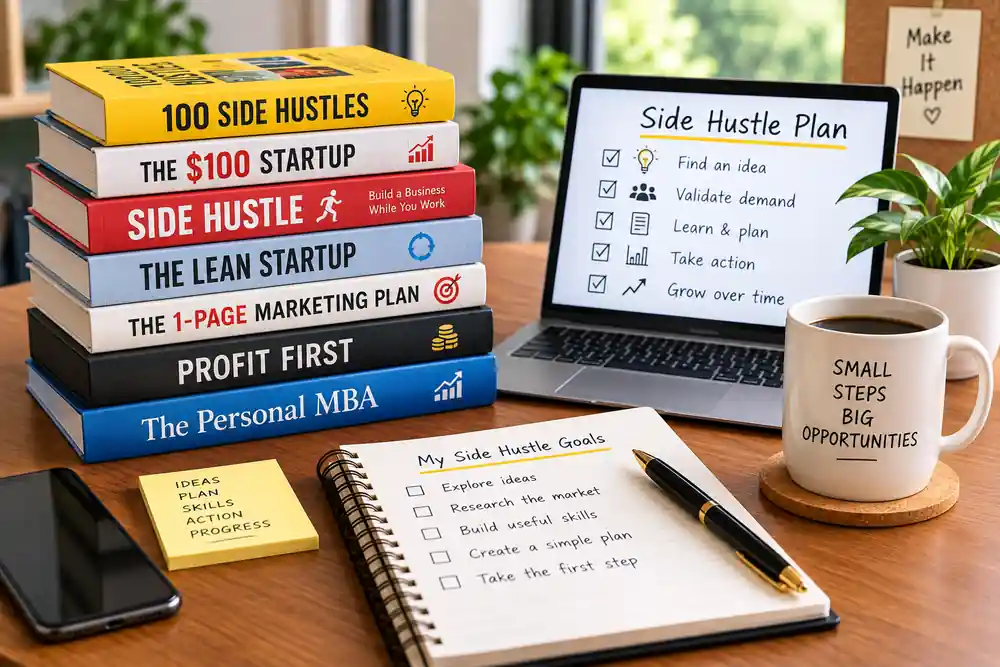
Starting a side hustle can be as simple as selling a skill you already have, or as involved as building an online store, consulting practice, digital product business, or content brand.
The difficult part is usually not finding another idea. It is figuring out which idea is worth testing, how much time and money to put into it, how to price the offer, and how to keep the finances organized once money starts coming in.
The right books can help, but reading alone does not validate a business idea. The most useful approach is to use books for frameworks and examples, then test those ideas with real potential customers.
If you are also working on your broader financial and career goals, see the CoreAdorn guide to Personal Finance & Career: Practical Tools, Books & Resources for U.S. Professionals.
Quick Answer: Which Side Hustle Books Should Beginners Read?
If you are starting from scratch, you do not need a shelf full of entrepreneurship books.
- 100 Side Hustles by Chris Guillebeau — useful when you need ideas and want to see different types of small businesses.
- The $100 Startup by Chris Guillebeau — useful for thinking about low-cost business models and simple offers.
- Side Hustle by Chris Guillebeau — useful if you prefer a step-by-step launch framework.
- The Lean Startup by Eric Ries — useful for testing assumptions before spending heavily.
- The 1-Page Marketing Plan by Allan Dib — useful for organizing customer acquisition and marketing.
- Profit First by Mike Michalowicz — useful for thinking about cash management and profitability.
- The Personal MBA by Josh Kaufman — useful as a broad reference covering marketing, sales, finance, pricing, operations and other business fundamentals.
You do not need to read all seven before taking action. For many beginners, one idea-focused book followed by one practical business book is enough to start testing an offer.
When you buy through links on our site, we may earn an affiliate commission at no extra cost to you. This helps support our work.
Who This Article Is For
This guide is for U.S. professionals, employees, students, parents and other adults who are considering a side business while maintaining another source of income.
It is especially useful if you:
- Have an idea but do not know where to start
- Want to turn an existing skill into a small business
- Are considering freelancing or consulting
- Want to sell products online
- Are thinking about creating digital products
- Want to build a content-based business
- Need help understanding basic business finances
- Want to avoid spending heavily before validating an idea
- Need a manageable way to organize a side project around a full-time job
It is not a substitute for advice from a tax professional, attorney, financial professional or other qualified adviser.
What Is a Side Hustle?
A side hustle is a small business, freelance activity, independent service, product business or other income-generating activity pursued alongside another primary job, career or source of income.
The term covers a wide range of activities.
A side hustle could involve selling your professional expertise, creating physical products, producing educational content, providing local services or building an online business.
The important distinction is that a side hustle is not automatically passive income. Many side businesses require regular customer service, marketing, fulfillment, bookkeeping and administrative work.
Common Types of Side Hustles
| Type | Examples | Main Challenge |
|---|---|---|
| Freelancing | Writing, design, programming, bookkeeping | Finding and retaining clients |
| Online business | Websites, memberships, newsletters, digital services | Building an audience or customer base |
| Local services | Cleaning, photography, tutoring, repairs | Scheduling and local competition |
| Digital products | Templates, guides, courses, printables | Creating something customers actually want |
| E-commerce | Handmade goods, private-label products, resale | Inventory, margins and fulfillment |
| Consulting | Business, marketing, technology, career expertise | Demo expertise and finding clients |
| Content creation | YouTube, blogs, newsletters, podcasts | Audience growth takes time |
| Skill-based business | Coaching, lessons, specialized services | Packaging and pricing the skill |
There is no single right side hustle. A practical starting point is usually the intersection of a skill you can provide, a problem someone has, and a customer willing to pay for a useful solution.
Side Hustle Ideas: Start With the Business Model
Before buying a business book, decide which type of side hustle interests you.
Freelancing
Freelancing involves selling a service directly to clients.
Examples include graphic design, copywriting, web development, video editing, bookkeeping, virtual assistance, translation, data analysis and social media management.
The advantage is that you can often start with skills and equipment you already have.
The limitation is that income is generally connected to finding clients and delivering work. Your available hours can also become a constraint.
Online Businesses
An online business can include a niche website, newsletter, membership, online service or other digital operation.
Online businesses can reach customers outside your local area, but that does not mean customers will automatically find you.
Marketing, search visibility, customer research and consistent publishing may become major parts of the work.
Local Services
Local businesses can include tutoring, pet care, photography, home organization, cleaning, lawn care, mobile detailing or other services.
These businesses may benefit from local demand and referrals.
The tradeoff is that you may need to travel, manage appointments and work around customers' schedules.
Digital Products
Digital products can include templates, spreadsheets, checklists, printables, educational guides, design assets, online courses and downloadable resources.
The attractive part is that a digital product can potentially be sold repeatedly without shipping a physical item.
The challenge is creating something useful enough that customers will actually pay for it.
E-Commerce
E-commerce includes selling physical products through an online storefront or marketplace.
Possible models include handmade goods, resale, private-label products and niche product collections.
The business can become more complicated because you may need to manage inventory, shipping, returns, customer support, product costs and marketplace fees.
Consulting
Consulting uses specialized knowledge to help businesses or individuals solve a problem.
Examples include technology consulting, marketing consulting, operations consulting, financial-process consulting, career consulting, HR consulting and industry-specific advisory work.
Consulting can be a natural fit for experienced professionals, but check your employment agreement for restrictions involving outside work, clients, intellectual property or conflicts of interest.
Content Creation
Content businesses can include YouTube channels, blogs, podcasts, newsletters and social media accounts.
Content can support advertising, sponsorships, affiliate marketing, products or services.
The major limitation is that audience-building can take considerable time, and there is no guarantee that a content business will generate meaningful revenue.
Skill-Based Side Businesses
A skill-based side business is often the simplest place to begin.
Instead of asking, "What business should I start?" ask: "What problem can I solve using a skill I already have?"
That question can narrow the possibilities considerably.
If your side hustle is connected to your professional career, our career planner guide for professionals can also help you think through longer-term skill development and career goals.
What to Read Before Starting a Side Business
100 Side Hustles by Chris Guillebeau
Best for: Finding ideas
What it covers: Real-world examples of people who created different types of small businesses.
Why consider it: If you have no clear idea yet, an idea-focused book can be more useful than a detailed accounting or marketing book.
The book presents examples across different industries and business models, making it useful for spotting patterns rather than copying someone else's exact business.
Important limitation: Case studies can provide inspiration, but another person's results do not predict yours. Treat the examples as starting points for research.
Who should consider it: Beginners who are still exploring possibilities.
Who may want something else: Someone who already has a specific business idea and needs a launch or validation framework.
The $100 Startup by Chris Guillebeau
Best for: Thinking about simple, low-cost business models
The $100 Startup focuses on small businesses built around skills, customers and relatively simple offers.
For a beginner, one useful takeaway is to think about the customer and the offer before building an elaborate business structure.
The book is particularly relevant to freelancers, consultants, creators and service businesses.
Important limitation: The examples are case studies, not a guarantee that a business can be started for a specific amount today. Costs vary significantly by industry, location, tools and regulations.
Who should consider it: Someone who wants to explore a lean business model.
Who may want something else: Someone building a product-heavy business with significant inventory or regulatory requirements.
Side Hustle by Chris Guillebeau
Best for: A structured starting process
Side Hustle is designed around moving from an idea toward an offer and a first customer.
This makes it a useful option for someone who tends to spend too much time researching and not enough time testing.
The important distinction is that a framework can help organize your actions, but it cannot prove that customers will buy your particular product or service.
Who should consider it: Beginners who want a step-by-step approach.
Who may want something else: Experienced business owners who already have customers and need more advanced financial or operational guidance.
The Lean Startup by Eric Ries
Best for: Validating an idea before investing heavily
The Lean Startup is useful for understanding how to test assumptions and learn from actual customer behavior rather than building everything first.
For a side hustle, that can mean:
- Identify a specific customer problem.
- Create a simple version of the offer.
- Show it to potential customers.
- Collect feedback.
- Look at actual buying behavior.
- Improve the offer based on what you learn.
This approach can be especially useful for online businesses, software ideas, digital products and e-commerce concepts.
Important limitation: Not every side hustle can be tested in exactly the same way. A local service, professional practice or regulated business may require different validation methods.
Who should consider it: People who have an idea but want evidence before committing significant money.
Who may want something else: Someone looking primarily for inspiration rather than experimentation.
Books and Resources by Business Question
Finding a Side Hustle Idea
Start with 100 Side Hustles , The $100 Startup or The Personal MBA .
Look for ideas that fit your existing skills, schedule, interests and access to potential customers.
Do not choose an idea simply because someone online claims it is profitable.
Validating an Idea
Useful resources include The Lean Startup , U.S. Small Business Administration market-research resources, customer interviews, competitor research and small-scale paid tests.
A simple validation exercise can be:
Problem - > Customer - > Existing alternatives - > Proposed offer - > Price - > Customer response
If you cannot clearly explain who has the problem and why they might choose your solution, more research may be needed before you spend money.
Marketing
The 1-Page Marketing Plan by Allan Dib
Best for: Organizing a marketing strategy
Marketing can become overwhelming when you are running a side business for only a few hours a week.
The 1-Page Marketing Plan provides a framework for thinking about prospects, customers and marketing activities.
That can be particularly useful for service businesses and small companies that need a straightforward customer-acquisition process.
Important limitation: A marketing framework does not replace knowledge of your particular audience. Your channels, messaging and costs will depend on your market.
Who should consider it: Freelancers, consultants, local service providers and small online businesses.
Pricing
The Personal MBA by Josh Kaufman
Best for: Understanding broad business fundamentals, including pricing and value
The Personal MBA is broader than a side-hustle book. It covers areas such as entrepreneurship, marketing, sales, negotiation, accounting, finance, productivity and operations.
For pricing, consider customer value, available alternatives, expertise, time required, direct costs, overhead, demand and positioning.
Do not price solely by copying a competitor.
Personal Finance
A side business should fit into your broader financial plan rather than undermine it.
Before spending $2,000 on equipment, software, inventory or advertising, consider whether the expense is necessary to test the idea.
Our guide to personal finance books for beginners can help with the broader money-management side of the decision.
Time Management
A side hustle competes with your existing responsibilities.
Ask:
- Which tasks actually require my involvement?
- Which tasks can be automated?
- Which tasks can be batched?
- What work produces useful customer feedback?
- What activities are merely keeping me busy?
For professionals building a side project around a full-time job, our productivity planners guide can be useful when deciding how to manage recurring tasks and limited work blocks.
Physical Product: Rocketbook Core Reusable Notebook
Best for: Capturing business ideas, customer questions and weekly plans
Why consider it: It combines handwritten notes with digital organization and is designed to be reused.
Limitations: It is not a substitute for accounting software or a proper business recordkeeping system.
Who should consider it: People who think better on paper but want the ability to digitize notes.
Who may want an alternative: Anyone who already manages ideas effectively in a digital notes or project-management system.
Taxes and Record Keeping
This is an area where beginners should rely on current official information rather than an old business book.
The IRS says gig-economy income generally must be reported, including income from part-time or side work. Tax obligations can vary depending on how the activity is structured and how you are classified.
The IRS also recommends keeping records of income and expenses.
Your recordkeeping system should make it possible to identify:
- Money received
- Business expenses
- Receipts
- Invoices
- Platform statements
- Mileage or other relevant records
- Equipment purchases
- Advertising expenses
- Professional-service expenses
The exact records and tax treatment depend on your circumstances.
Do not assume that an expense is deductible simply because it is related to your side hustle. Check current IRS guidance or consult a qualified tax professional.
Our tax organizer guide for U.S. households can help you think about physical organization of receipts and documents.
Physical Product: Smead All-in-One Income Tax Organizer
Best for: Keeping receipts and tax-related paperwork together
Why consider it: A physical expanding organizer can make it easier to keep receipts and supporting documents in one place.
Limitations: A paper organizer does not replace digital bookkeeping, accounting software or professional tax advice.
Who should consider it: Side-hustle owners who receive physical receipts or prefer paper-based organization.
Who may want an alternative: Someone who already maintains complete digital records and scans documents immediately.
Cash Management and Profitability
Profit First by Mike Michalowicz
Best for: Thinking about cash allocation and business profitability
A side hustle can generate sales without generating much usable profit.
That happens when expenses, fees, subscriptions, inventory, advertising and other costs consume more cash than expected.
Profit First presents a behavioral cash-management approach designed to make profitability part of the financial system rather than something left over after spending.
The concept can be useful for a growing side business, but beginners should understand that the book's framework is a management approach, not personalized accounting or tax advice.
Who should consider it: Side-hustle owners who have started generating sales and want a clearer way to think about business cash.
Who may want something else: Someone who has not yet tested an idea and does not have meaningful business cash flow to manage.
Scaling a Side Hustle
Scaling should not automatically mean working more hours.
A side hustle may eventually grow through higher-value services, better systems, repeat customers, productized services, digital products, better marketing, delegation, automation, improved pricing or narrower specialization.
But scaling too early can create unnecessary expenses.
You may not need expensive software, a large inventory order, a complicated website or contractors before you know that customers want your offer.
The better question is:
What constraint is currently preventing the business from serving more customers profitably?
A Practical Side Hustle Reading Path
Stage 1: Find an Idea
Read 100 Side Hustles or The $100 Startup .
Goal: Identify several possible business models.
Stage 2: Understand Business Fundamentals
Use The Personal MBA as a reference.
Goal: Understand value, marketing, sales, pricing, finance and operations.
Stage 3: Test the Idea
Read The Lean Startup .
Goal: Test assumptions before making major investments.
Stage 4: Build a Marketing Plan
Use The 1-Page Marketing Plan .
Goal: Identify your target customer and a manageable way to reach them.
Stage 5: Manage the Money
Consider Profit First once the business has actual revenue and expenses to manage.
Goal: Develop a disciplined approach to business cash flow.
Stage 6: Organize Your Time
Use a productivity system that fits your working style. Our guide to productivity planners for busy professionals compares different formats and use cases.
A Simple Side Hustle Validation Checklist
- Who is the customer?
- What problem are you solving?
- How does the customer solve that problem today?
- What are the alternatives?
- Why might someone choose your offer?
- What would the customer have to pay?
- What does it cost you to deliver?
- How much time does each customer require?
- Can you test the offer without a large upfront investment?
- What evidence would tell you to continue, change direction or stop?
Side Hustle Products Worth Considering
You do not need a special collection of entrepreneurial gadgets.
A few practical physical products can be enough.
| Product | Best For | Key Consideration |
|---|---|---|
| Rocketbook Core | Ideas and planning | Useful if you prefer handwriting |
| Smead Tax Organizer | Paper receipts and documents | Does not replace digital records |
| Brother P-touch Label Maker | Organizing supplies and files | Most useful when physical organization is substantial |
Brother P-touch Label Maker
Best for: Organizing physical inventory, files, storage boxes and business supplies
Why consider it: A label maker can be useful if your side hustle involves physical inventory, equipment, shipping supplies or a growing collection of documents.
Limitations: It is unnecessary for many digital businesses.
Who should consider it: E-commerce sellers, craft businesses, photographers, local-service businesses and home-based sellers with physical supplies.
Who may want an alternative: Freelancers and consultants whose work is almost entirely digital.
How to Choose the Right Side Hustle Book
Use the question you are trying to answer.
| Your Question | Resource Type | What You Need |
|---|---|---|
| What could I do? | Idea book | Examples and possibilities |
| Is my idea worth testing? | Validation resource | Customer research and experiments |
| How do I find customers? | Marketing book | Positioning and customer acquisition |
| How should I manage money? | Finance resource | Cash flow and recordkeeping |
| How do I fit this around work? | Productivity resource | Time and task management |
| How do I grow? | Business operations resource | Systems, pricing and process |
This approach is more useful than buying a stack of books because each purchase has a specific job.
Who Should Start a Side Hustle?
A side hustle may make sense for someone who:
- Has a marketable skill
- Has enough time to serve customers reliably
- Wants to explore entrepreneurship without immediately leaving a primary job
- Can afford modest experimentation without compromising essential finances
- Is willing to handle administrative work as well as the creative work
A side hustle may not be appropriate right now if it requires money you need for essential expenses, creates a conflict with your employment, or requires substantially more time than your current schedule allows.
Before starting, review your employment agreement and any applicable professional or licensing requirements.
Who Should Skip the "Side Hustle" Trend?
You do not need a side business simply because other people have one.
If your primary goal is career advancement, you may get more value from improving your professional skills, pursuing a promotion or preparing for a job change.
Our interview preparation books guide and salary negotiation books and resources can be useful if your priority is increasing your effectiveness in your existing career.
Likewise, if debt is the primary financial concern, building a side business may not be the first step. Our debt payoff planner guide covers tools for organizing debt repayment.
Common Side Hustle Mistakes
1. Buying Equipment Before Finding Customers
A new laptop, camera, printer, inventory order or software subscription can feel like progress. It is only progress if it helps you solve a real business problem.
2. Choosing an Idea Because Someone Else Made Money From It
Another person's business model does not guarantee the same result for you. Study the underlying customer problem instead.
3. Ignoring the Numbers
Track revenue and expenses from the beginning. A side business with sales can still lose money.
4. Underpricing Every Service
Low prices may make an offer easier to sell, but they can also leave you with insufficient time to deliver quality work. Consider the full cost of providing the service.
5. Trying Five Ideas at Once
Multiple experiments can become five unfinished projects. Start with one test that can produce useful customer feedback.
6. Mixing Personal and Business Records
Even a small side business benefits from organized records. Use a system that clearly identifies business income and expenses.
7. Treating Social Media Attention as Business Validation
Views, likes and followers are not the same as customers. Look for stronger evidence such as inquiries, sign-ups, preorders, consultations or purchases when appropriate.
8. Ignoring Your Existing Job
A side business should not cause missed deadlines, conflicts of interest or misuse of your employer's time and resources. Check your employment policies before proceeding.
Frequently Asked Questions
What is the best book for someone who has no side hustle idea?
100 Side Hustles by Chris Guillebeau is a useful starting point for idea generation because it presents many different small-business examples. It is better viewed as an idea source than a prediction of what will work for you. Once you identify an idea, move into customer research and validation rather than assuming the example itself proves demand.
Which book is best for validating a side hustle idea?
The Lean Startup by Eric Ries is useful for understanding experimentation and testing assumptions. The practical application is to build a small version of an offer, put it in front of potential customers and learn from their response before committing significant resources. The exact testing method should be adapted to the type of business you are considering.
Do I need to read business books before starting a side hustle?
No. Books can help you avoid common mistakes and understand business concepts, but reading should not become a substitute for testing. If you already have a promising idea, a small customer experiment may teach you more about that particular market than reading several additional books.
Are side-hustle earnings taxable in the U.S.?
Generally, income from gig or side work may be taxable and must be reported according to applicable federal tax rules. The IRS provides specific guidance for gig workers and self-employed individuals. Your exact obligations can depend on your circumstances, so use current IRS guidance and consult a qualified tax professional when necessary.
Should I spend money on equipment before getting customers?
Usually, avoid unnecessary upfront spending when you can test the idea without it. Some businesses require equipment from the beginning, but many service and digital businesses can start with tools you already own. Identify the minimum equipment needed to deliver a credible test rather than building the full business before validating demand.
Can a side hustle become a full-time business?
It can, but there is no guaranteed path from side business to full-time income. Before considering a transition, look at consistent demand, revenue, expenses, cash reserves, insurance and benefits, taxes and the stability of the business. A decision to leave employment should be based on your own financial circumstances rather than someone else's success story.
Should I choose a side hustle based on my current career?
Your existing career can be a useful source of skills and knowledge, but it is not your only option. A professional skill may make freelancing or consulting easier to start, while a hobby or newly learned skill may lead to a different type of business. Check your employer's policies for conflicts, confidentiality and outside work.
What physical products are useful for a side hustle?
Most beginners need less equipment than they expect. A notebook or reusable planning system can help with ideas and tasks, while a tax organizer can help keep paper records together. A label maker may be useful for e-commerce or inventory-heavy businesses. Buy physical products when they solve a real organizational or operational problem.
Final Thoughts
A side hustle does not need to start with a complicated business plan or a large investment.
Start with a problem you understand, a skill or resource you can use, and a specific customer. Use books to improve the way you think about the business, then validate your assumptions with real-world feedback.
If you are building a side business as part of a larger financial or career strategy, return to the broader Personal Finance & Career resource hub as you work through budgeting, career planning, productivity, taxes and other practical decisions.
The goal is not to collect the most business books. It is to learn enough to make better decisions, test one idea carefully, keep good records and decide what deserves your time.
CoreAdorn is reader-supported. When you buy through links on our site, we may earn an affiliate commission.
0 Comments
Be the first to comment.
Leave a comment
Please use kind words and keep your comment on topic. Comments are reviewed by the CoreAdorn team before they appear.